Translate

Monday, October 7, 2013

Bathroom mini makeover


Bathroom mini makeoverIf you've long wanted the elegance of natural stone in your home, consider a new granite bathroom vanity top, which is a great, affordable way to get it. You can now find granite tops at Lowe's, Home Depot and other home centers. Prices range from $150 to $450 depending on the size. Complete this bath makeover with a new faucet and mirror, and you'll still keep the price under $500.
Begin by ordering your new items and don't start the project until you have them all on hand. Be sure to inspect them for flaws (a common problem). Then tear out the old fixtures and repair the walls as needed. Keep the old vanity if it's in good shape. But paint it to freshen it. Use a few cans of spray paint to get a smooth finish and avoid brush marks. And replace the old pulls with new ones to dress it up.
Next, paint the walls and add the new mirror. If your old mirror included a recessed medicine cabinet, make sure the new one fits within the existing opening. Enlarging the opening often expands the job considerably!
Finally, mount the faucet, install your new granite top and connect the plumbing. Whew! If all goes well, you'll finish in a long weekend.
Cost: Granite vanity top, 31 in. long, $200; faucet, $130; 24 x 36-in. mirror, $60; paint and cabinet pulls, $40. Total: $430.
Time: Two to three days.
Original Article: The Family Handyman

Sunday, October 6, 2013

Conventional Loan


Conventional Loan History
MortgageA mortgage conventional loan is a lender agreement that's not guaranteed or insured by the federal government under the Veterans Administration (VA) the Federal Housing Administration (FHA), or the Rural Housing Service (RHS) of the U.S. Department of Agriculture. Although a conventional loan is not insured or guaranteed by the government, it can still follow the guidelines of government sponsored enterprises (GSE's) such as Fannie Mae or Freddie Mac as both Fannie Mae and Freddie Mac are stockholder-owned corporations and are not part of the federal government.
At one point in the United States, conventional loans were the only mortgage loans available and they were all issued by local lenders such as banks, savings and loans, and credit unions. These private lenders kept and serviced these loans in their own portfolio until they were either paid in full or foreclosed on.
In the late 1930's, a secondary market was created which allowed these local lenders to sell their loans, getting the full payment much more quickly. Then, the organizations that purchased the loans owned the agreement and collected payments from the borrower. Today it is very common for lenders to sell their loans on the secondary market.

Types of Conventional Loans

Conventional loans may be "conforming" and "non-conforming". Conforming loans follow the terms and conditions set by Fannie Mae and Freddie Mac. The 2009 conforming loan limits remain at the limits set in 2006, 2007 and 2008. These guidelines put the maximum price for a first mortgage at $417,000 for a single-family dwelling. If the purchase is made outside of the 48 contiguous United States (in Guam, the Virgin Islands, Hawaii, or Alaska), or the dwelling is for a two-family, three-family, or four-family configuration, larger values apply before the loan is no longer considered a conventional loan.
Nonconforming loans don't meet Fannie Mae or Freddie Mac qualifications, but that are still considered conventional. Jumbo loans are one example of a conventional loan that does not meet Fannie Mae or Freddie Mac guidelines. A jumbo loan is a loan with a dollar value above the maximum loan amount established by Fannie or Freddie. Jumbo loans usually have a higher interest rate.
Conventional loans can be fixed rate mortgages, adjustable rate mortgages, balloon mortgages, or hybrid loans. Almost any type of loan that you take, if not issued by a government entity, is considered a conventional loan.

Saturday, October 5, 2013

Enrique Iglesias sells Bay Point home for $6.7M

Mansion was highest-priced sale per sf in private Miami neighborhood's history


enrique
Enrique Iglesias and aerial view of Bay Point in Miami
Singer Enrique Iglesias sold his waterfront mansion on Bay Point at Biscayne Bay in Miami yesterday for $6.7 million.
The home, located at 4411 Sabal Palm Road, was the highest-priced sale per square foot in the history of the private neighborhood, according a spokesperson for EWM Realty International. Iglesias had the 6,400-square-foot estate built in 1998. It features five bedrooms, six bathrooms and 100 feet of frontage on the water.
Esther Percal of EWM Realty and Christie’s International Real Estate represented Iglesias, while Robert Evangelista of One Sotheby’s International Realty represented the undisclosed buyer.
The 38-year-old Iglesias and his longtime tennis-star girlfriend, Anna Kournikova, recently hit the rocks because she is tired of waiting for him to propose marriage, a source told the New York Post. — Mark Maurer
Published on The Real Deal


Friday, October 4, 2013

7 Projects That Add Value to Your Home

couple home improvementMany projects do add value to your home, and improve your family’s quality of life. By working on these projects now, you can enjoy the benefits and updates. If you make green upgrades, then you can also start recouping your investment in these green energy technologies once you complete the projects.
Some home improvement projects that add value to a home include:

1. Remodeling the Kitchen

Most people consider the kitchen to be the heart of the home, and because of this, updates in this room pay off. According to HGTV, you can expect to recoup 60%-120% of your investment on a kitchen remodel, as long as you don’t go overboard. You should never make your kitchen fancier than the rest of the house, or the neighborhood.
Why You Shouldn't Invest in a Deluxe Kitchen
For example, a historic home in my neighborhood has been on the market for more than two years. During the owner’s last open house, I went in to check it out, and immediately saw why the house hasn't sold. The quaint Arts and Crafts style home was built in 1900 and has a lot of charm. Unfortunately, the homeowners had invested over $60,000 upgrading the kitchen.
The enormous kitchen, easily the size of the living room, features appliances and counter tops that might look more at home in a fancy restaurant kitchen. The style, size, and quality of the kitchen don’t fit in with the rest of the house, or the neighborhood. If you plan on selling your home within the next five years, keep potential buyers in mind before you start on any major remodel; many people won’t pay for a fancy, deluxe kitchen.
A Little Paint Goes a Long Way
When it comes to how much you spend on a kitchen remodel, prices can run the gamut, from $5,000 to $75,000, or more. Get the biggest bang for your buck on a kitchen remodel by looking at color. Fresh paint, in modern colors, can go a long way towards updating the look of your kitchen. Plus, paint is relatively cheap.
You might want to consider using low-VOC paint; this makes your kitchen more eco-friendly, and helps your family avoid breathing in dangerous chemicals, like benzene, that off-gas from regular fresh paint.
Energy-Efficient Appliances
Replace old appliances with energy-efficient models. Energy Star-rated appliances are better for the environment, and they also help you save money, because they use less energy. Potential buyers often look for ways to save money when shopping for a new home.
modern kitchen

2. Bathroom Addition

If your home only has one bathroom, you can recoup a large chunk of your investment by adding another one. HGTV estimates that you can recoup 80%-130% of whatever you spend adding a bathroom.
When it comes to finding room in your house for an extra bathroom, take a look at any extra rooms or underutilized spaces. Consider other spaces, such as closets or areas under the stairs, too. If you want a half-bath you need at least 18 square feet. If you want a full bath, including a stand-up shower, you need at least 30 square feet. If you want a bathtub, make sure you have at least 35 square feet to work with for a bathroom addition. 
Like any project, the cost of adding a bathroom depends largely on the types of additions and accessories you want to use, and the cost of each of these items. You can save money by frequently checking Lowe’s and Home Depot; they often drastically reduce prices on sinks and toilets that have been floor models. 

3. Reinventing a Room

Adding more square footage to your home with a new room can be an incredibly expensive project. Although you can recoup some of your investment, anywhere from 50%-83%, this project’s costs can quickly spin wildly out of control. Just turn on any of those home remodeling TV shows; projects that start off with a $15,000 budget quickly turn into $30,000 or more when homeowners and contractors run into unexpected problems.
Reinvent the existing space in your home to save money. Finish a basement, or convert the attic to a bedroom. Many homeowners can also add small apartments in, or over, their garages – which they can then rent out as a room.
Before you demolish walls and rafters, try to think about the ways that you, and potential buyers, can use the space:
  • Versatile rooms have greater appeal to potential buyers.
  • Basements frequently work well as second living rooms, or game rooms. Many people also turn this space into a small apartment for an aging relative or a tenant.
  • Attic spaces often work well for craft rooms and game rooms, especially if they have high ceilings. If you have kids, you can add swings to the rafters, and create a cool play room just for them.
According to Remodeling Magazine’s annual Cost vs. Value report, an average basement remodel, with the addition of a wet bar, costs $64,000. You can save a significant portion of this by doing the work yourself, but even then, adding a new room can be expensive.
attic bedroom

4. Adding Energy-Efficient Windows

These days, buyers shop for homes with energy efficiency in mind. Old, drafty single-pane windows are a major turn off. Energy Star claims that adding Energy Star-rated windows can save you up to $500 a year in heating and cooling costs by making your home more energy efficient.
According to HGTV, you can expect to recoup 60%-90% of your costs when you invest in energy-efficient windows. You can also receive a green energy tax credit of 10% for this upgrade, as long as you install Energy Star-rated windows. You might also qualify for additional credits from your state, or even your utility company.
Learn more about available offers and rebates in your area by visiting the Energy Star Rebate Finder. They have a searchable database that gives you specific information for your state. Just make sure you check “windows” so you get product-specific information. I searched for energy-efficient rebates in my zip code and discovered that my utility company, DTE, offers rebates to customers who install Energy Star windows.
Energy Star estimates that the average cost of window replacement in an average-sized home costs $7,500-$10,000, or more. If the new windows save you several hundred dollars a year, and you recoup a tax credit, you can eventually recoup your investment.

5. Deck Addition

Adding a deck increases the value of your home. Outdoor living spaces have become more desirable, especially since more people stay home for vacation (i.e. referred to as a staycation). If you make your deck and your backyard more appealing, your house will be more appealing to prospective buyers when you decide to sell. HGTV claims that homeowners recoup 65%-90% of their investment by adding a deck.
The cost of adding a deck to your home varies widely. Everything depends on its size, and how many bells and whistles you want added, like built-in seating, multiple stairs, built-in flower pots, and the size of the deck. Decks can cost anywhere from $1,200 to $10,000, or more. Again, it all depends on the design and materials used.
As you might guess, you can save a huge chunk of the cost, usually half, by doing the work yourself. Keep in mind, however, that deck construction isn’t easy. You need specific tools, such as a bandsaw, and the cost of the tools can be very expensive, especially if you don’t plan to use them again.
If you decide to hire a contractor, shop around before you choose someone to work with. Make sure you get at least three quotes, with specifics, from the contractors you interview. Thoroughly check references for the contractors before you agree to a contract or work order, and watch out for home improvement repair scams. Sites like Angie’s List can ensure you hire a contractor you can trust.
house deck

6. Energy-Efficient Insulation

If your home lacks basic insulation, and has old doors that let in plenty of hot and cold air, home inspectors working with potential buyers will include this in their reports. Homes that haven’t been modified with energy efficiency in mind cost more to live in and maintain.
Updating your home to save energy doesn’t have to cost a lot of money and can make your home more appealing to potential buyers. You can save $2,500 or more each year just by making some changes. For example, you can add extra insulation to your attic for $200 or less, and this small change can save you hundreds each year on your utility bill.
Seal cracks around the house to save even more money on energy costs, and to make your home more appealing to buyers. The U.S. Department of Energy (USDE) estimates that the average house has enough leaks to equal a 3×3 foot hole in the wall. You can find leaks in your home during the winter. Anytime you feel a draft or cold spot, you’re in an area that leaks air. You can purchase a thermal leak detector for $40 or less (e.g. Black & Decker TLD100 Thermal Leak Detector). These handheld devices alert you to temperature differences around your home. This then allows you to add caulk or insulation where you need it the most.
You can often discover leaks, and areas that need more insulation, in these areas:
  • Around doors and windows
  • Around electrical sockets and light switches
  • In recessed lighting
  • Around the attic hatch
  • In the basement
  • Anywhere ducts or wires go outside the house
Another easy retrofit is to use CFL light bulbs in all light fixtures. CFL bulbs use 75% less energy than traditional bulbs and each one saves, on average, $40 in energy over the course of its lifetime. You also save on cooling costs because CFLs emit 75% less heat than traditional bulbs. You can easily calculate how much you can save simply by counting the number of lights you have in your home.
You can also install a programmable thermostat. Most buyers expect to see programmable thermostats these days, and they can save you money. Energy Star estimates that installing a programmable thermostat will save the average homeowner $180 per year in heating and cooling costs.
If you need to replace your hot water heater, consider spending a bit extra to purchase a high-efficiency water heater. Savvy home buyers know these water heaters can really trim energy bills. If you use less than 41 gallons of water each day in your household, a tank less water heater saves you 24%-34% on your water heating costs. If you use more, count on a savings of 8%-14%.

7. Basic Updates

Basic updates add the most value to your home. Keep the paint fresh, fix the roof when it leaks, replace wood that rots, and get rid of any mold that you find. These types of chores keep your home from deteriorating over time. Buyers want a healthy, solid, safe home, and they look carefully for signs of routine maintenance.
I’ve replaced the electric wiring in my home, repainted the outside, replaced the plumbing, and repainted the interior. These projects keep my home in tip-top shape so that when I do decide to try and sell again, buyers will see a well-cared-for home.
couple insulation attic

Thursday, October 3, 2013

Creating a High-End Kitchen on a Shoestring Budget

By: Danny Lipford
Minor kitchen makeover included refinishing cabinets and countertops.
A minor do-it-yourself kitchen remodel provides one of the highest rates of return for the money invested and is also a great way to make your kitchen more attractive, functional, and energy efficient.
So if your kitchen has seen better days, consider some of the options below for your next DIY home improvement project.

Kitchen Countertop and Cabinet Makeover

Rather than going to the expense of ripping out your existing kitchen countertops and cabinets and replacing them, consider refinishing them instead!
Start by removing the cabinet hardware, then thoroughly clean the cabinets and countertops to remove any grease and grime.
Giani Granite Paint for Countertops.
To bring a brand new look to out-of-date plastic laminate countertops, apply Giani Granite Countertop Paint to give your countertops the look of real granite at a fraction of the cost.
Read our article on DIY Faux Granite Countertop Finish and watch our video on How to Apply Faux Granite Countertop Paint to find out how.
To improve the look of your kitchen cabinets, lightly sand the cabinets and apply one or two coats of clear finish to natural or stained wood cabinets to make them look like new.
Another option that can really change the look of a kitchen is to prime and paint kitchen cabinets white or a bright color.
The final touch to give your kitchen a new look is replacing the knobs, hinges, and pulls on the cabinets. 

Improve Kitchen Indoor Air Quality

Broan Range Hood.
Broan Range Hood.
Did you know that the air inside your home can be more polluted that the air outdoors?
With houses built tighter than ever to save energy, it’s important to provide proper ventilation, particularly in your bathroom and kitchen, to expel the stale air in your home.
Cooking releases large amounts of both heat and moisture in your home, and installing an efficient range hood vented to the outside is the best way to remove it.
Range hoods from Broan, such as the model QSE130, are a great budget-friendly choice.
Broan QSE130 range hoods are available in black, white, and stainless steel and are 50% quieter than average hoods while using 30% less energy.

Energy Saving Kitchen Makeover

Duck Roll-On Window Kit.
While working on making your kitchen more attractive and efficient, don’t forget to consider implementing energy savings, such as replacing bulbs in hanging, recessed, and undercounter light fixtures with either CFL or LED bulbs.
Another way to save big on your energy bills and make your kitchen more comfortable in both winter and summer is by weather stripping around exterior doors and windows.
Speaking of windows, to really keep out the cold, install Duck Roll-On Insulating Film Indoor Window Kits on single pane windows.

Wednesday, October 2, 2013

Bob Hope Estate in Toluca Lake

Celebrity Real Estate 
By: 
Realtor.com


The Hopes commissioned Robert Finkelhor, an authority on Period Revival styles, to build their beloved English traditional house on a former walnut grove in 1939. It was later remodeled “in a more contemporary style” in the 1950s by architect John Elgin Woolf, who also designed homes for Cary Grant, Errol Flynn, Judy Garland, Ricardo Montalban and Katharine Hepburn.
The longtime Toluca Lake estate of late comic actor Bob Hope and his wife, Dolores, has come to market for $27.5 million.
The estate grew considerably over the years as the Hopes acquired surrounding properties, and it now consists of a total of four parcels totaling 5.16 acres, reports the Los Angeles Times. A main house of 14,876 square feet, as well as a two-bedroom guest house, a two-bedroom staff quarters, and additional offices can all be found on the storied compound.
Leading through a reception area, the home opens to a handsome foyer with hardwood flooring and a curving spiral staircase. Interior amenities include an office, a billiards room, a chef’s kitchen and a formal living room lined in floor-to-ceiling glass that looks onto a post-and-beam patio and grounds. The upstairs houses four bedroom suites, including a master wing with his and her bedrooms, baths, closets and a shared study. Outside, the home rounds out with sports facilities, including a one-hole golf course, a pair of pools, one indoor and one outdoor, numerous patios and a massive stone motor court.
The Hope estate became something of a Toluca Lake landmark over the years, thanks to “its celebrity owners and for doling out the best Halloween loot, from full-size candy bars to silver dollars, and for a larger-than-life nativity scene displayed at Christmas.” Memorabilia seekers were able to buy many of the Hopes’ holiday decorations, as well as furniture and other household items, at a garage sale in December.
Bob Hope lived at the property from 1939 up until his passing in 2003. Dolores Hope passed away in 2011. The Toluca Lake estate represents the last of Hope’s impressive real estate portfolio to come to market since his wife’s passing. In December 2012, a pair of Palm Springs properties owned by the late couple listed for $659,000 and $469,000.
Those homes, while charming, paled in comparison to the Hopes’ John Lautner-designed home, which was offered in March as a pocket listing for a whopping $50 million. Overlooking Coachella Valley, the 23,000-square-foot-plus property was designed by Lautner in 1973 to resemble a volcano, and has long since earned icon status in the midcentury modern hotbed that is Palm Springs. It reportedly sold in less than one month.
Jade Mills of Coldwell Banker and Drew Fenton of Hilton & Hyland are the listing agents.

Tuesday, October 1, 2013

How to refurbish your cabinets

by Claire Gallam


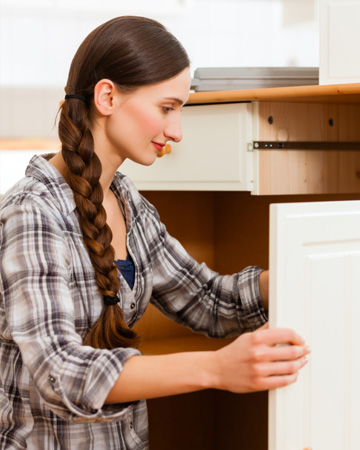
Woman updating cabinet

How to Update your Cabinets


Tired of your kitchen old cabinets? Try your hand at refurbishing them yourself! It's easy as removing cabinet doors, removing stain and repainting. So save the money you'd spend on a costly handyman and buy some new dishes or fancy gadgets to fill your snazzy new cabinets! 

This is one DIY that you would be crazy not to tackle yourself. Just like staining your wooden floors, refurbishing your cabinets only sounds harder than it is. Just enlist the help of your husband or friends and be done in no time!


What you'll need: 

  • Screwdriver
  • Paint stripper
  • Sandpaper
  • Wood putty and wood putty knife
  • Wood conditioner (if cabinets are wood)
  • Stain or paint
  • Primer
  • Vacuum

Step 1: Remove old cabinet doors

Using your screwdriver, remove the cabinet doors and associated hardware from the hinges. If your cabinet has drawers inside, remove those draws as well and place with the doors for refurbishing. Also remove the hardware and ornaments from your doors, like the handles. Use your vacuum to suck up any debris and give the inside of the cabinet a thorough wipe through. In addition, be sure to wipe off any smudges or dirt from your cabinet doors.

Step 2: Repair and update cabinets

If your cabinets have any major damages, like deep gashes, holes or dents, use the wood putty to fill them in. Use putty that is the same color you plan to paint or stain to avoid obvious wear and tear to your cabinets. If the cabinets hold smaller items, like spices or bottles, install a lazy susan or drawers to make organizing easier. No use in updating the outside if the inside is a disorganized mess!

Step 3: Strip paint or stain

Using a commercial paint stripper, remove the old paint or stain from your cabinets and cabinet doors and drawers. If you don't have a paint stripper, sand off the old paint or stain, using sandpaper or a professional grade sander. Both options will work. Once the paint and stain has been removed, use a damp towel or cloth to wipe away any debris or loose pieces left by the removal process.

Step 4: Repaint, restain and let dry

If you are choosing to stain your cabinets, apply the stain by rubbing it into the wood using an old rag or sponge. To give the cabinets the most natural look, apply the stain in even strokes going with the grain of the wood. Allow the first coat of stain to dry completely before you apply a second coat to avoid gunk build up. Once your second coat of stain has been applied and has dried, you'll need to apply a coat of polyurethane, which will help protect the stain from fading or water damage. Repeat the same process with the doors as well.

Step 5: Update cabinet hardware

Be sure your cabinet doors are completely dry before you replace the handles. Nothing adds some character to cabinets quite like cute handles and ornaments! To keep your kitchen's feng shui in check, choose handles that go with the rest of your theme, whether that be sleek and modern or vintage and old-fashioned. For a fun, kitchen theme, turn your old spoons into handles with this fun, antiquey DIY. You can also buy assorted cabinet handles and pulls at stores like Anthropologie and mix and match for a unique, eclectic look. 

Step 6: Reattach doors

Using the screwdriver and set of screws you saved from when you removed the doors; simply reattach the door where it was previously. If you have drawers inside your cabinet, reattach those first so you can ensure you don't scratch any of the paint or stain on the newly painted doors.